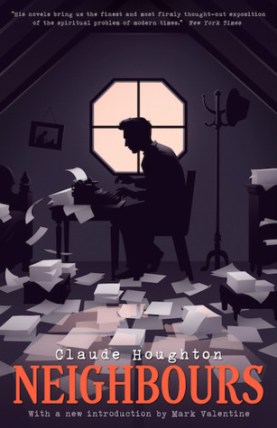
Book Title: Neighbours
Author: Claude Houghton and Introduction by Mark Valentine
Publisher: Valancourt Books
Number of pages: 186
Genre: classic, fiction, thriller, psychological thriller
Release Date: (original 1926) release: April 29th 2014
Favorite Quotes:
“No, I haven’t, and I don’t pretend that I have. I’m like a leaf in the wind. I’m at the mercy of every new theory and swayed by every gust of emotion. You say I corner others and try to find out their ideas. I do. They may have what I’m looking for. Anyway, I want to find out what it is in them that makes their lives possible. I simply cannot believe that people are what they appear to be. They can’t live that! It’s impossible. I tell you, Hen, I’m interested only in one thing when I talk to a man or a woman, and that is-what is his or her creed. No, listen! I don’t mean what I say ‘creed’ any rubbish about Church, or what they give out as being their views concerning God. Oh dear, no! I mean the values that really affect their everyday lives.”
“My life is the most ghastly contradiction of all. My mind says there are no values-none. But my heart still worships at the alters which my mind has destroyed. That’s true, and that’s hell. My heart loves beauty; it loves all earth; and it loves all the high hopes and mighty cravings of men. It loves on-blindly and without reason. My mind cries: ‘That thing you worship is false; it’s a lie!’ But my heart merely repeats its monotonous answer: ‘I love, I love, I love.’ Well, one can’t go on living like that. But one does go on living like that. Yes, it’s true. My heart urges me to create things of beauty, and my mind says: ‘Ah, so you are like the others. You are going to make a pretty little garden on the dung-hill. That will be nice. Another coward has taken another allotment in hell.’ That’s how it goes on with me-day after day. I’m not better than the rest-I’m worse. That’s why I hate them. A real drunkard always despises the man who has a fling now and again.”
“But we create an image of what we are, and as we grow and develop the image alters. So that to-day we deny what yesterday we affirmed. But we all make an answer to life, and that answer springs from what we love. There are so many worlds as there are men and woman. No two mirrors reflect identically the same thing.”
“But it always fascinates me to see an audience. They seem to be paying others to live for them. They kill things in themselves in order to get money, and then they spend the money to watch an expression of those very things they have destroyed in themselves. Then they applaud, go home, and count their money. I am the only person in the whole wide world who understands the strange poverty of the rich.”
“The thing is part of a bigger problem. You can’t settle it on its own. We all try to. We divide our lives into compartments, isolate our problems, and then try to solve each separately. It’s hopeless. There’s either something that makes the whole thing organic or there’s nothing-in which case we’re wasting our time. It’s no damned use to tear a branch from the Tree of Life, break it into pieces while it is withering in our hands, and then ponder as to how to make it bear fruit. If your life as a whole has a principle-which is not obtained by the arbitrary creation of a mental scheme to justify the universe-then you’ll get a perspective throughout your life. And not otherwise.”
“The Articles of a man’s actual creed are written in his face. I know the nature of the thought, for it expresses itself relentlessly in the face, and it is easy for me to conceive of a man so gifted in this study that we could have only to see a man in order to know all the inner and hidden life of that man.”
“The ultimate tragedy of a life lived within the restrictions of an iron routine is that it fears the responsibility imposed by choice. To obey becomes easy; it becomes an escape, and the desire to initiate, to act, dies within one. Of all the enemies by which the soul menaced, the most deadly is Habit. The other foes make a frontal attack, but Habit surrounds the soul. It lays siege, and its dread ally is Time. All unaware, the soul surrenders its citadel.”
“Victor realized that these people, for all their apparent confidence, were like sleep-walkers, whose greatest fear was that they should be awakened. But he also saw that these people managed to get through the world somehow, and that they derived a kind of fictitious strength from the very fact that there were so many of them.”
“Each failure to conform merely brought him back to his original Quest. But he thought of another possible way of escape from his burden. There were the outcasts-those who made no attempt to conform with the standards of culture of the values of respectability. One could plunge into a life, every aspect of which revealed a complete defiance of all accepted standards.”
“I’ve met every type of humanity except the ‘average man.’ He is a person we invent in order to deceive ourselves into thinking that we are exceptional people.”
“I may. The most awful thing in the world is a nice white sheet of virgin paper on one’s desk-looking at one. One sits down, and in a minute or two, that blank of piece of paper looks like a photograph of one’s mind.”
“The best people nowadays are the most muddle, the most disturbed. It’s difficult to explain what I mean. They don’t seem to know what to do with their vitality. They’ve seen through so many things that deceive the majority, and yet they’ve not found anything to put their money on, so to speak. Well, in the end, in a kind of desperation, they fling themselves into something to which they don’t belong.”
“Life is to be measured not by duration but by intensity.”
“The fact that I was dealing with the Past was an escape from the problems of the Present; but now the writing of this narrative is painful to me. I am like a man with nothing to leave who is making his will. I only continue to write through habit, for although this work seems a short one, for every page that I have retained I have destroyed ten that I have written… “
“Boredom is the greatest product of civilization. I shiver when I hear people talk about boredom in a light way. I’m convinced that crime attracts a lot of people simply because it appears to be exciting. It’s the same with vice, and that is why people get so furious when they discover that vice is dull. My dear, believe me when I say that what is called the love of adventure is really only the fear of boredom. Men rush into war because they imagine that, whatever else it may be, it won’t be dull. Nowadays, they are disappointed because modern war is monotonous, like everything else.”
“Do you remember that you once told me that one doesn’t fall into love, but that one climbs towards it?”
Goodreads Synopsis:
The narrator of Neighbours is a young writer who has taken a room in the attic of a lodging house, where he hopes to find a quiet atmosphere in which to work. One night, the sound of laughter outside his door alerts him to the existence of Victor, a fellow lodger in an adjoining room. The narrator feels an immediate and inexplicable hatred for his unwanted neighbour, which develops into an obsession as he listens to Victor’s fervent conversations and amorous adventures through the thin wall and records it all in minute detail on endless sheets of paper. His morbid fascination with Victor gradually begins to dominate his existence, leading to a shocking climax when he finally resolves to destroy his neighbour, the man he blames for ruining his life . . .
Claude Houghton (1889-1961) won a devoted cult following in the 1930s with I Am Jonathan Scrivener (1930) and This Was Ivor Trent (1935), psychological thrillers with brilliantly sharp dialogue and unusual metaphysical themes. This edition of his astonishingly original first novel, Neighbours (1926), is the first in over 75 years and features a new introduction by Mark Valentine.
“[G]rew upon me with every page, until I came to the dramatic climax … often brilliant … [with] the brilliance of fever, almost of delirium.” – Punch
“It is very shocking … [Houghton] has proved himself to possess considerable talent.” – Spectator
“Neighbours is a novel about ideas concerning life. It is full of dialogue, and good dialogue. It has beautiful moments. It is original.” – Arnold Bennett, Evening Standard
“In Claude Houghton’s work you have come to expect not only an unusual and fast-moving story, but one with its hidden excitements or seeming touch of fantasy, the significance of which may not be apparent until you have reached the last page.” – Sunday Times
“His novels bring us the finest and most firmly thought-out exposition of the spiritual problem of modern times.” – New York Times
My Review:
5/5 stars
This book was an ABSOLUTE whirlwind!! I had my doubts at first about this book because my typical genre has been YA, and books that I have been reading right now have been written in recent years. I never thought I would pick up a book written in 1926, but I was curious as to what it was about. In the beginning, I struggled a little to understand what was happening. Once I got over the fact that this WASNT a typical book I would normally read, I finally began to understand it. This book has what I love most about books: AMAZING quotes/ intriguing theories. There were so many theories about people, how they interact with one another, and how one perceives life to be. I was blown away by the words in the story, and loved the way in which the characters spoke to one another and discussed ideas (which seems to be so rare nowadays). This is one case that I was glad I judged a book by its cover, because I was curious to find out the story behind the haunting cover. I would recommend this book to people over 18… Simply because of the in-depth conversations the characters have and the different ways in which people speak to one another, compared to now. Please read!!
Author Websites:
 Living in a World of Book Quotes